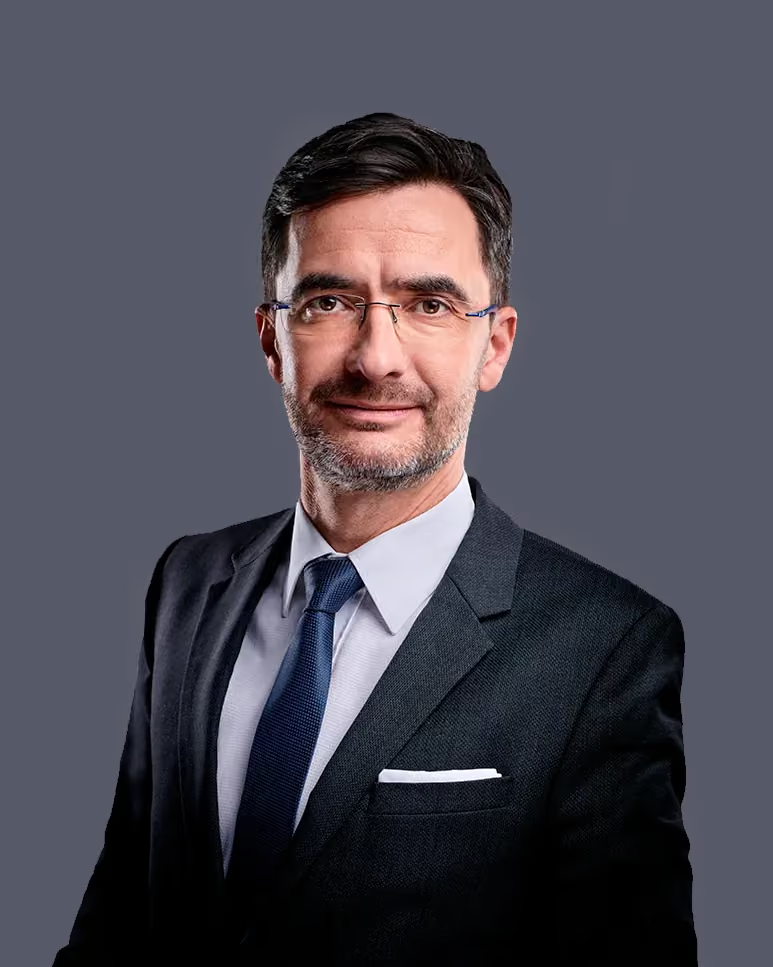
“In the early 2010s, people in Korea used to say that Poland was ‘the China of Europe’, a vast factory of limitless possibilities.”
Dr Marcin Dudarski, Managing Partner at JP Weber, and Chan Woo Bin, Head of Korean Desk, interviewed by Business Insider Polska.
Rafał Tomański, Business Insider Polska: How did this report come about, and how did you start working with Korean companies in Poland?
Dr Marcin Dudarski, Managing Partner at JP Weber: Let me start with a few words about our firm. For almost 20 years, we have specialised in mergers and acquisitions, transaction advisory and restructuring. Our main focus is on cross-border projects. Asian companies readily use our services, which is why we work so closely with investors who choose Poland as the right location for their investments. We are also a co-founder of Eight International, a global organisation specialising in transaction advisory and restructuring, which makes it much easier for us to deliver projects for international clients.
We have a team of more than 60 people and two offices in Poland, in Warsaw and Wrocław. We started building the firm as a kind of start-up. I know the word “start-up” sounds rather unusual for an advisory firm, but that is exactly what we were, in today’s sense of the word. Over the years, we have built up our capabilities and gained experience. Today we can confidently say that we are a match for the Big Four firms - in fact, many people from those firms are now developing their careers with us.
In its early years, JP Weber advised German companies that wanted to invest in Poland, and because one of our four partners is German, it was easier for us to build trust. Two of our Polish-born partners grew up and studied in Germany, while I was based on the eastern side of the Oder, and this allowed us to build these cross-border capabilities effectively. We realised that the German way of doing business could deliver the quality the Polish market needed at the time.
In 2004, Poland joined the EU and the foreign direct investment (FDI) market opened up to non-European companies. That was when Asian companies first appeared in our client portfolio. We noticed interest from several South Korean companies looking for a way into Poland. The site where LG has now located its investment was originally meant for Hyundai (which eventually chose the Czech Republic and Slovakia). Halfway through Hyundai’s contract negotiations in Poland, the Korean tyre maker Hankook also appeared. LG was the third investor from Korea that wanted to come to Biskupice Podgórne near Wrocław.
Because of our distinctive approach to clients - our motto is to advise businesses from the owner’s perspective - we began to develop our cooperation with partners in Korea. It was 2006, and we did it entirely on our own. That was when I first visited Korea myself. We also worked with the Warsaw office of Korea Exim Bank, which is backed by the Korean government. Together, we prepared the first report on opportunities for Korean investors. The Korean ambassador recommended us on its first page, and from then on we began to visit our partners on the Korean Peninsula regularly. Since then, we have also worked with the Polish Investment and Trade Agency (PAIH).
Read the full interview on Business Insider Polska (in Polish).
Source: Business Insider Polska